What are greenhouse gases?
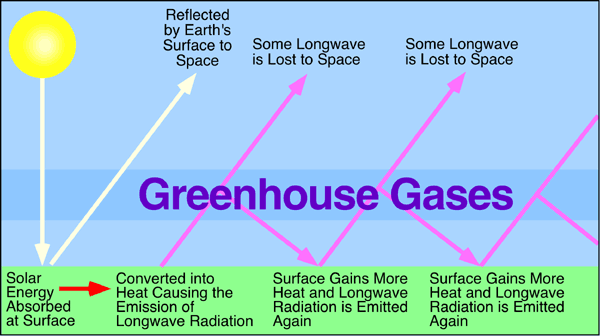
Greenhouse gases are gases in an atmosphere that absorb and emit radiation within the thermal infrared range. This process is the fundamental cause of the greenhouse effect. The main greenhouse gases in the Earth's atmosphere are water vapor, carbon dioxide, methane, nitrous oxide, and ozone. In our solar system, the atmospheres of Venus, Mars and Titan also contain gases that cause greenhouse effects. Greenhouse gases greatly affect the temperature of the Earth; without them, Earth's surface would be on average about 33 °C (59 °F) colder than at present.
The burning of fossil fuels since the beginning of the Industrial revolution has substantially increased the levels of carbon dioxide in the atmosphere.
The main sources of greenhouse gases due to human activity are:
1) Burning of fossil fuels and deforestation leading to higher carbon dioxide concentrations. Land use change account for up to one third of total anthropogenic CO2 emissions.
2) Livestock enteric fermentation and manure management, paddy rice farming, land use and wetland changes, pipeline losses, and covered vented landfill emissions leading to higher methane atmospheric concentrations. Many of the newer style fully vented septic systems that enhance and target the fermentation process also are sources of atmospheric methane.
3) Use of chlorofluorocarbons in refrigeration systems, and use of cholorofluorocarbons and halons in fire suppression systems and manufacturing processes.
4) Agricultural activities, including the use of fertilizers, that lead to higher nitrous oxide (N2O) concentrations.
Adapted from: http://en.wikipedia.org/wiki/Greenhouse_gas



The burning of fossil fuels since the beginning of the Industrial revolution has substantially increased the levels of carbon dioxide in the atmosphere.
The main sources of greenhouse gases due to human activity are:
1) Burning of fossil fuels and deforestation leading to higher carbon dioxide concentrations. Land use change account for up to one third of total anthropogenic CO2 emissions.
2) Livestock enteric fermentation and manure management, paddy rice farming, land use and wetland changes, pipeline losses, and covered vented landfill emissions leading to higher methane atmospheric concentrations. Many of the newer style fully vented septic systems that enhance and target the fermentation process also are sources of atmospheric methane.
3) Use of chlorofluorocarbons in refrigeration systems, and use of cholorofluorocarbons and halons in fire suppression systems and manufacturing processes.
4) Agricultural activities, including the use of fertilizers, that lead to higher nitrous oxide (N2O) concentrations.
Adapted from: http://en.wikipedia.org/wiki/Greenhouse_gas
Done by: Nicole